How to Talk to Teens About Internet Safety Without Pushing Them Away
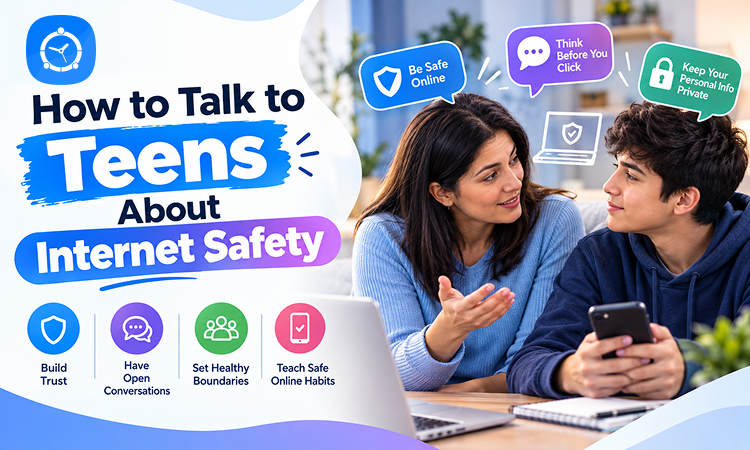
How to Talk to Teens About Internet SafetyTalking to teenagers about internet safety can be tricky.
Tell them too little, and they may not recognize online risks. Lecture them too much, and they may stop listening altogether.
For today’s teens, the internet isn’t a separate part of life. It’s where they talk to friends, study, play games, watch videos, discover new interests, follow creators, and express themselves. Social media, messaging apps, gaming communities, and AI tools are part of their everyday world.
That’s why internet safety conversations shouldn’t sound like:
“The internet is dangerous, so don’t trust anyone.”
A better goal is to help teens develop the judgment to recognize risky situations themselves—and make sure they know they can come to you when something goes wrong.
Here’s how parents can talk to teens about internet safety without turning every conversation into a lecture.
Why Internet Safety Conversations With Teens Matter
Teenagers are becoming more independent, but independence doesn’t mean they no longer need guidance.
Online risks can appear in many forms, including:
- Cyberbullying
- Online strangers
- Scams and phishing
- Inappropriate content
- Sextortion
- Fake profiles
- Deepfakes and AI-generated content
- Privacy risks
- Location sharing
- Account hacking
- Excessive screen time
- Pressure to share intimate images
Parents can’t realistically stand beside their teenager every time they open an app.
That’s why teaching digital judgment matters.
The goal isn’t to prepare teens for one particular app or threat. Apps will change. New trends will appear. New technologies will create new risks.
Good judgment travels with them.
1. Start With Curiosity, Not Accusations
Imagine beginning a conversation with:
“You’re spending too much time online. Who are you talking to all day?”
A teenager may immediately become defensive.
Instead, try showing genuine interest.
Ask questions such as:
“What apps are everyone using at school right now?”
“What’s your favorite thing about that game?”
“Have you seen anything weird happening on that app?”
These questions can give parents a window into their teenager’s digital life without making the conversation feel like an interrogation.
You may also learn about apps, slang, trends, or online communities you didn’t know existed.
2. Don’t Make Every Conversation About Screen Time
Screen time is important, but it shouldn’t dominate every discussion about technology.
If every conversation starts with “Put your phone down,” teens may begin associating parental involvement with restrictions.
Instead, talk about what happens during screen time.
A teenager spending an hour messaging close friends has a very different experience from someone spending an hour interacting with strangers in an anonymous chat room.
Ask about the people they communicate with, the content they watch, the communities they join, and how being online makes them feel.
Quality matters alongside quantity.
3. Explain the “Why” Behind Your Rules
Teenagers are more likely to question rules than younger children.
That’s not necessarily a bad thing.
Instead of saying:
“Don’t share your location because I said so.”
Explain the reason:
“If your account is public and your location is visible, people you don’t know may be able to figure out where you regularly spend time.”
The same principle applies to private accounts, passwords, unknown friend requests, intimate images, and online purchases.
When teens understand the reason behind a boundary, they have something they can apply when you’re not around.
4. Talk About Online Strangers Realistically
“Never talk to strangers online” sounds simple, but it doesn’t always reflect how teenagers use the internet.
They may encounter unfamiliar people while gaming, participating in communities, commenting on videos, or joining group conversations.
A more useful conversation focuses on what information should remain private and what behavior should raise concerns.
Explain that someone they meet online isn’t automatically trustworthy just because they seem friendly or share the same interests.
Warning signs can include someone who:
- Immediately asks for personal information
- Wants conversations kept secret
- Pressures them to send photos
- Constantly asks where they are
- Offers gifts or money
- Wants to move conversations to a private platform
- Becomes sexual or inappropriate
- Threatens or manipulates them
- Pressures them to meet in person
Teach teens to judge behavior rather than simply trusting a username, profile picture, or claimed age.
5. Have the Sexting Conversation—Even If It’s Uncomfortable
Parents may prefer to avoid conversations about intimate images.
But avoiding the subject doesn’t prevent teens from encountering it.
Explain calmly that once an image is sent, control over that image can be lost. It might be saved, forwarded, screenshotted, manipulated, or used to embarrass or blackmail someone.
Teens should also understand that receiving an intimate image does not give them permission to share it.
The conversation should include sextortion as well.
Tell your teen that if anyone ever threatens to expose a photo, video, message, or secret unless they pay money or provide more content, they should come to you immediately.
Most importantly, say this explicitly:
“Even if you made a mistake, you can still tell me. We’ll deal with the problem first.”
Fear of punishment should never become the reason a teenager hides a dangerous situation.
6. Explain That AI Can Fake What They See
Internet safety conversations now need to include artificial intelligence.
AI can generate convincing images, voices, videos, messages, and other content. Deepfake technology can even make it appear that someone said or did something that never happened.
Encourage teens not to automatically believe shocking content simply because it looks realistic.
Teach them to pause and ask:
Who posted this?
What’s the original source?
Can I verify it somewhere trustworthy?
Could this image, video, or audio have been manipulated?
Is someone trying to make me react before I think?
AI literacy is quickly becoming part of basic digital literacy.
7. Talk About Privacy Before Something Goes Wrong
Teenagers often understand privacy as:
“My account is private, so I’m safe.”
But online privacy is more complicated.
Even a private account can expose personal information through followers, screenshots, tags, bios, photos, and conversations.
Sit down together occasionally and review privacy settings.
Look at who can:
- View their posts
- Send direct messages
- See their location
- Tag or mention them
- Add them to groups
- See their friends or followers
- Comment on their content
Also review what their profile reveals.
A username, school name, sports uniform, location tag, birthday, and regular check-ins can collectively reveal more than a teenager realizes.
8. Teach Teens to Recognize Online Scams
Teenagers can be attractive targets for scammers because they may have less experience recognizing manipulation.
Scams can arrive through gaming chats, social media messages, emails, fake giveaways, online shopping offers, or compromised friends’ accounts.
Teach teens to be suspicious of messages that create urgency:
“Your account will be deleted today.”
“You won a free phone—claim it now.”
“Send me the verification code.”
“Click here for free game currency.”
“I accidentally reported your account.”
A useful family rule is simple:
Stop before you click.
If a message creates panic, promises something unusually valuable, or asks for a password or verification code, verify it independently first.
9. Talk About Cyberbullying From Both Sides
Internet safety isn’t only about protecting teens from other people.
It’s also about teaching them how their own behavior affects others.
Talk about what to do if someone is being bullied in a group chat, gaming lobby, comment section, or social media post.
Make it clear that forwarding an embarrassing image, joining a pile-on, or sharing a cruel joke can contribute to the harm even if they didn’t create the original content.
If your teen is being targeted, encourage them to save relevant evidence, block or report the account when appropriate, and tell a trusted adult.
Remind them that leaving a toxic group chat isn’t weakness.
Sometimes it’s the smartest option.
10. Discuss Digital Footprints Without Trying to Scare Them
“You’ll never get a job because of that post!” probably isn’t the best way to teach digital responsibility.
Instead, explain that online content can travel beyond its intended audience.
A post shared with friends today might be screenshotted, forwarded, or rediscovered later.
Before posting something, encourage teens to ask:
Would I be comfortable if someone outside my intended audience saw this?
It’s a simple habit that encourages thinking before posting without making teens afraid to participate online.
11. Make Internet Safety an Ongoing Conversation
Don’t try to cover the entire internet in one serious family meeting.
That can quickly turn into a lecture.
Instead, use everyday moments.
If you hear about a social media scam, mention it over dinner.
If your teen tells you about a strange message, ask what they think about it.
If a new app becomes popular, explore it together.
If there’s a news story about a deepfake, use it to discuss AI-generated content.
Short, regular conversations can be more effective than one annual “internet safety talk.”
12. Avoid Overreacting When Your Teen Tells You Something
This may be one of the most important points.
Imagine your teenager finally tells you:
“Someone online asked me for a picture.”
If the immediate response is anger—
“I told you not to talk to strangers! Give me your phone!”
—what lesson might they learn?
Possibly:
Don’t tell Mom or Dad next time.
You can still enforce rules and consequences when necessary. But deal with the safety issue first.
Thank them for telling you. Find out what happened. Help them block or report the person when appropriate. Preserve evidence if there are threats or exploitation.
Then discuss what can be learned from the situation.
You want your teenager’s instinct during an online crisis to be:
“I need to tell my parents.”
Not:
“I need to hide this from my parents.”
13. Create Family Internet Rules Together
Teenagers may respond better to boundaries when they have some involvement in creating them.
Sit down together and agree on basic expectations.
Your family’s rules might include:
- Keep passwords private.
- Use strong, unique passwords and available security protections.
- Ask before meeting an online-only friend in person.
- Don’t share intimate images.
- Never share verification codes.
- Review privacy settings regularly.
- Tell a parent about threats, blackmail, or sexual messages.
- Keep devices out of bedrooms during agreed sleep hours.
- Respect other people’s privacy online.
- Talk to a trusted adult when something feels wrong.
The exact rules will depend on your teenager’s age, maturity, and circumstances.
As teens demonstrate responsible behavior, boundaries can evolve.
How FamilyTime Can Support Healthy Digital Boundaries
Good internet safety begins with communication, but parental controls can help families put agreed boundaries into practice.
FamilyTime provides parents with tools for managing children’s device habits and access to apps and online content.
Parents can use App Blocker to restrict apps they consider inappropriate and Daily App Limits to manage how much time children spend on particular apps.
With Screen Time Schedule, families can establish device-free periods around bedtime, schoolwork, meals, or family time.
FamilyTime’s Web Blocker can also help parents restrict inappropriate websites and create a more age-appropriate browsing environment.
These tools work best when teens understand why they’re being used.
Instead of presenting parental controls as:
“I don’t trust you.”
Try:
“We’re giving you more independence, but these are the digital boundaries we’re using while you learn to manage that independence responsibly.”
Parental controls shouldn’t replace communication. They should support the expectations families have already discussed.
Give Teens More Responsibility as They Earn It
Internet safety isn’t about controlling every digital decision until a child turns 18.
The long-term goal is independence.
As teenagers demonstrate good judgment, parents can gradually adjust boundaries.
Maybe that means later device hours, more freedom to download apps, or fewer restrictions on certain activities.
When teens understand that responsible behavior leads to greater independence, online safety becomes less about parental control and more about learning self-control.
A Simple Conversation Starter for Parents
Not sure how to begin?
Try this:
“I know you’re online a lot, and I’m not trying to monitor every conversation you have. I just want you to know that scams, fake accounts, inappropriate messages, and other uncomfortable situations can happen to anyone. If anything online ever scares you or gets out of control, you can tell me. We’ll figure it out together.”
Then listen.
Your teenager’s response may tell you more than a 30-minute lecture ever could.
Final Thoughts
Talking to teens about internet safety doesn’t require parents to understand every app, game, meme, or social media trend.
It requires something more important: open communication, reasonable boundaries, and trust.
Teach teens how to recognize suspicious behavior, protect personal information, question what they see online, respond to cyberbullying, recognize scams, and ask for help when a situation becomes uncomfortable.
Tools such as FamilyTime can help parents reinforce those boundaries by managing apps, web access, and screen time. But technology alone cannot teach judgment.
The ultimate goal isn’t to make every online decision for your teenager.
It’s to help them reach the point where they can make safer decisions for themselves—and know that when they need help, they can always come to you.